
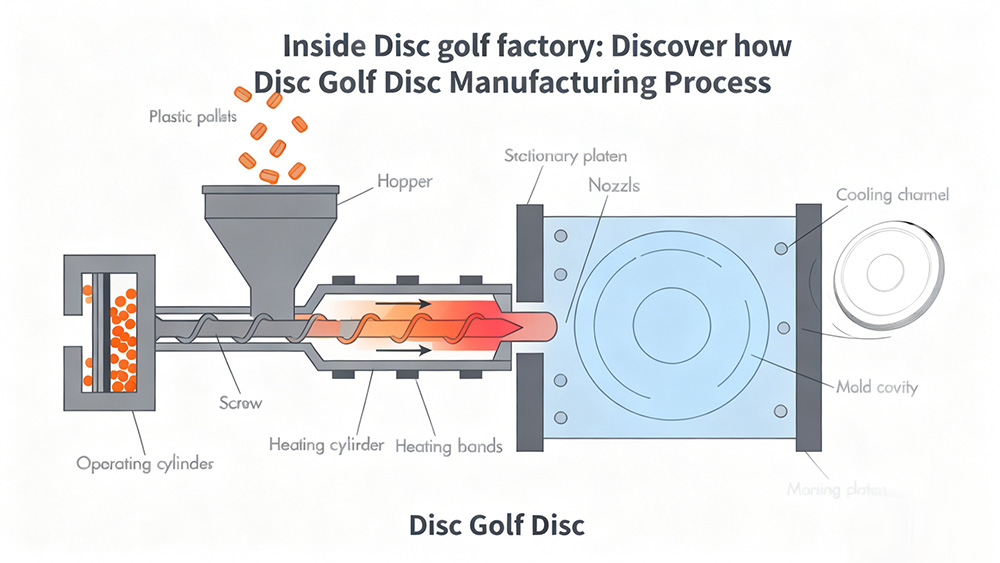
Inside Disc golf factory: Discover how Disc Golf Disc Manufacturing Process
Disc golf discs represent a remarkable fusion of sports equipment design and precision manufacturing. While they may appear simple at first glance, the creation of these flying discs involves sophisticated engineering, advanced materials science, and rigorous quality control processes. This comprehensive guide explores the entire manufacturing journey—from raw plastic pellets to finished, flight-ready discs—revealing why certain plastics perform differently and how manufacturers achieve consistent flight characteristics across thousands of units.
La Fondation: Raw Materials and Their Properties
The Disc Golf Disc Manufacturing process begins with the selection of raw materials, primarily various thermoplastic polymers that determine the disc’s durability, flexibility, poignée, et caractéristiques de vol. Different manufacturers use proprietary blends, but most discs fall into several key material categories:
Polyethylene-Based Compounds (par ex., Innova’s DX Plastic): These entry-level materials offer excellent grip and affordable production costs but wear relatively quickly. The base polyethylene is often blended with additives to enhance flexibility and reduce brittleness.
Polycarbonate Blends (par ex., Innova’s Champion Plastic): Known for exceptional durability and transparency, polycarbonate discs maintain their flight characteristics longer than other plastics. Manufacturers often add UV stabilizers to prevent discoloration and degradation from sunlight exposure.
Proprietary Premium Blends (par ex., ESP de Discraft, MVP’s Neutron): These advanced formulations combine multiple polymers to achieve specific performance characteristics. For instance, some blends incorporate rubberized components for enhanced grip, while others use reinforcing agents for increased rigidity.
Thermoplastic Elastomers (par ex., Gateway’s SSS): These flexible materials bridge the gap between rubber and plastic, offering superior grip and unique flight characteristics, particularly popular for putters and approach discs.
The raw materials typically arrive at manufacturing facilities in pellet form, colored with masterbatch pigments that ensure consistent coloration throughout the disc. These pellets are vacuum-loaded into storage silos where they’re kept dry until the molding process begins.
Étape 1: Mold Design and Engineering
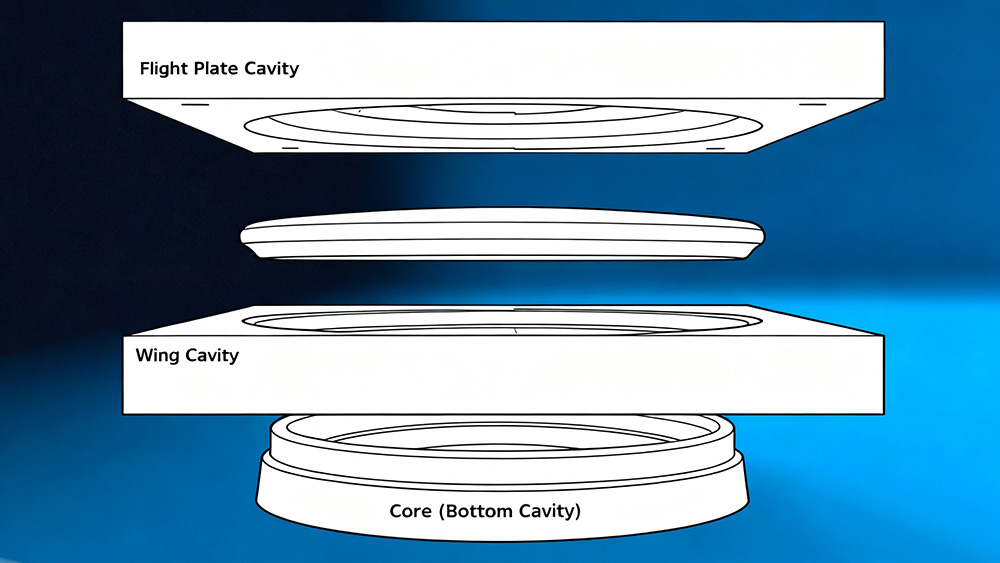
Before production can commence, manufacturers create precision molds that define the disc’s shape, rim configuration, et caractéristiques de vol. This process involves several stages:
Conceptual Design: Engineers and professional players collaborate to create disc designs that meet specific flight requirements. Using computer-aided design (CAD) software, they develop virtual models that simulate aerodynamics and predict flight patterns.
Precision Machining: Once the design is finalized, mold makers use computer numerical control (CNC) machines to carve the mold cavities from hardened steel or aluminum. These molds typically consist of two halves that form the disc’s top and bottom surfaces, plus additional components for creating the parting line and sprue (the channel through which molten plastic enters the mold).
Prototype Testing: Manufacturers produce small batches of prototype discs for rigorous testing, both in controlled environments and on actual disc golf courses. Professional players provide feedback on flight characteristics, leading to iterative refinements of the mold design until the disc performs as intended.
The mold itself represents a significant investment, often costing between 50,000 depending on complexity and materials. This explains why manufacturers typically require substantial minimum order quantities for custom disc dessins.
Étape 2: The Injection Molding Process
Injection molding transforms plastic pellets into finished discs through a highly controlled thermal and mechanical process. This occurs in several phases:
Material Preparation and Drying: Plastic pellets are transferred from storage silos to drying hoppers where they’re heated to remove moisture. Proper drying is critical, as residual moisture can cause cosmetic defects and structural weaknesses in the finished discs.
Plastic Melting and Injection: The dried pellets enter the injection molding machine’s barrel, where rotating screws and heating bands melt them into a viscous liquid. Once the plastic reaches the optimal temperature (typically between 350°F and 450°F, depending on the material), the injection molding machine uses hydraulic or electric pressure to force the molten plastic into the closed mold cavity. This injection phase lasts only seconds but must be precisely controlled to ensure complete filling without defects.
Cooling and Solidification: After the mold cavity fills, the plastic begins cooling immediately. Cooling time varies based on material thickness and type but typically ranges from 30 à 60 seconds. During this phase, the plastic solidifies into the exact shape of the mold, including all flight-critical features like the rim configuration, wing shape, and bottom geometry.
Ejection and Finishing: Once sufficiently cooled, the mold opens and ejector pins gently push the finished disc from the cavity. Workers then remove excess plastic from the sprue and parting lines, either manually or using automated trimming equipment. For discs with special finishes (like metallic or pearlescent effects), additional surface treatments may be applied at this stage.
Advanced manufacturers like Yikun employ fully automated injection molding systems that can produce a disc every 45-60 seconds, with minimal human intervention beyond quality control checks.
Étape 3: Specialized Manufacturing Techniques
While most discs are produced using standard injection molding, several specialized techniques create unique product characteristics:
Overmolding Technology (used by MVP Disc Sports): This innovative process involves creating a disc with two distinct plastic types—typically a rigid outer rim and a softer inner flight plate. The process requires injecting the first material, allowing it to partially cure, then injecting the second material to form a mechanical bond. This creates unique flight characteristics not achievable with single-material construction.
Foam Core Manufacturing: Some manufacturers experiment with foam-core discs that have a solid outer skin and a lighter foam interior. This reduces weight without significantly compromising structural integrity, creating discs that are particularly suitable for beginners or players with lower arm speed.
Multi-Shot Molding: For discs with complex color patterns or material combinations, manufacturers may use multi-shot molding machines that can inject different materials or colors in sequence, creating vibrant visual effects without the need for post-production painting.
Étape 4: Quality Control and Testing
Quality assurance is integral to the Disc Golf Disc Manufacturing process, ensuring that every disc meets performance standards:
Dimensional Verification: Automated vision systems or manual calipers check critical dimensions like diameter, rim depth, and parting line height. Discs that fall outside tolerance ranges (typically ±0.5mm for diameter) are rejected.
Weight Consistency: Each disc is weighed to ensure it falls within the approved weight range for its mold. Professional-grade discs typically maintain weight consistency within ±3 grams across production runs.
Flight Stability Testing: Many manufacturers employ mechanical throwing machines that launch discs at consistent speeds and angles to verify flight characteristics. While not every disc undergoes this testing, regular sampling ensures that production runs maintain expected flight patterns.
PDGA Certification Testing: For discs intended for tournament use, manufacturers submit samples to the Professional Golf à disque Association for official certification. This process verifies that the disc conforms to size, poids, and flight standards required for competitive play.
Étape 5: Customization and Branding
After passing quality control, discs may undergo customization processes:
Hot Stamping: Metallic foil is applied to the disc surface using heated metal dies that transfer the foil onto the plastic. This creates durable, weather-resistant branding ideal for logos and artwork.
Pad Printing: For multi-color designs, manufacturers use pad printing technology that can apply complex graphics with precise registration. This method allows for full-color artwork but is generally less durable than hot stamping.
UV Printing: Some manufacturers now offer direct UV printing, which creates photorealistic images on the disc surface. While visually striking, this method typically costs more and may affect the disc’s grip characteristics.
Environmental Considerations and Sustainability
Modern disc manufacturing has increasingly focused on environmental responsibility:
Recycled Materials: Many manufacturers now incorporate post-consumer recycled plastic into their blends, particularly for baseline plastic formulations. This reduces environmental impact without significantly compromising performance.
Energy Efficiency: Advanced injection molding machines use servo-electric drives that consume significantly less energy than traditional hydraulic systems, reducing the carbon footprint of disc production.
Waste Reduction: Sprue and runner systems have been optimized to minimize plastic waste, with many manufacturers regrinding and reusing these byproducts in future production runs.
The Future of Disc Manufacturing
Emerging technologies promise to revolutionize disc golf manufacturing:
Additive Manufacturing: While not yet economical for mass production, 3D printing enables rapid prototyping and could eventually facilitate fully customized disc designs tailored to individual players’ preferences.
Matériaux intelligents: Research into materials that change flexibility or surface characteristics in response to temperature or impact could lead to discs that automatically optimize their flight characteristics for different conditions.
Biodegradable Polymers: Several manufacturers are experimenting with biodegradable plastic alternatives that would reduce the environmental impact of lost or discarded discs.
Conclusion: Precision Engineering Meets Athletic Performance
The creation of golf à disque discs represents a sophisticated interplay between materials science, precision engineering, and athletic performance requirements. From the initial selection of polymer blends to the final quality control checks, each step in the Disc Golf Disc Manufacturing process contributes to the flight characteristics that players rely on. Understanding this process not only deepens appreciation for the equipment but also informs better purchasing decisions, as players can now match specific manufacturing characteristics to their individual playing styles and performance needs.
As manufacturing technologies continue to evolve, we can expect even more sophisticated discs that offer enhanced performance, greater durability, and reduced environmental impact—pushing the boundaries of what’s possible in the sport of disc golf.
Références
Disques Innova. (2025). Plastic Technology and Injection Molding. Récupéré de https://innovadiscs.com/technology/
Discréter. (2025). Manufacturing Excellence: How We Make Discs. Récupéré de https://www.discraft.com/manufacturing/
MVP des sports de disque. (2025). Gyro Technology and Overmolding Process. Récupéré de https://mvpdiscs.com/technology/
Pdga. (2025). Equipment Standards and Certification Process. Récupéré de https://www.pdga.com/technical-standards
Plastics Today. (2025). Injection Molding Innovations in Sporting Goods. Récupéré de https://www.plasticstoday.com/injection-molding-sporting-goods
Modern Plastics. (2025). Polymer Selection for Sports Equipment. Récupéré de https://www.modernplastics.com/polymer-selection