

Disc Golf Forehand Basics: Beginner Sidearm Guide for Distance & Accuracy
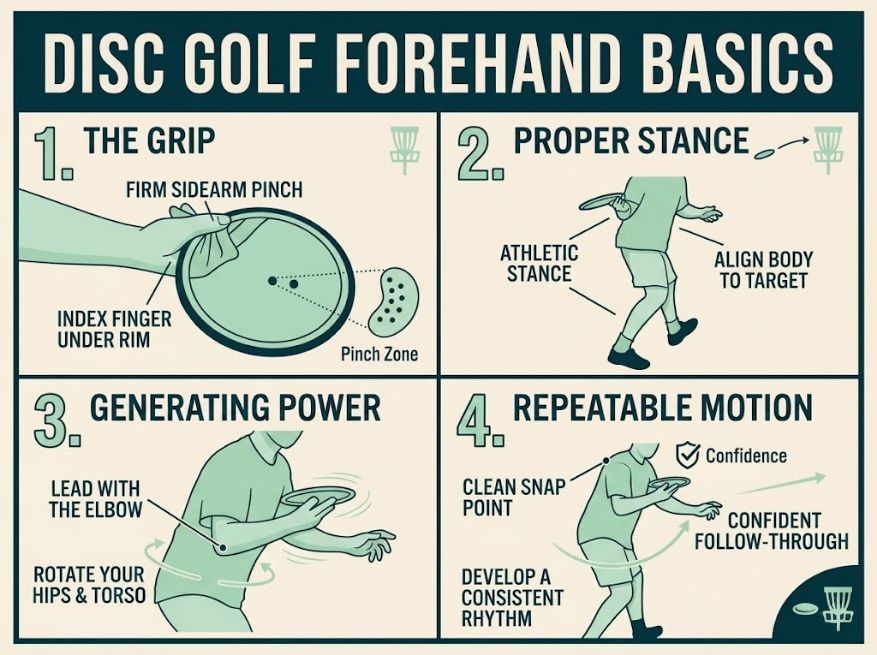
The forehand throw, also called the sidearm throw, is one of the most important skills in disc golf. While many beginners first learn backhand mechanics, developing a reliable forehand creates more shot options, improves course management, and helps players escape difficult angles on the course.
A good forehand throw combines wrist snap, clean release timing, balanced footwork, and efficient arm mechanics. Unfortunately, many beginners struggle with wobble, elbow discomfort, poor accuracy, or limited distance because they rely too much on arm strength instead of proper technique.
This complete beginner guide explains disc golf forehand basics, including grip techniques, wrist mechanics, elbow positioning, weight transfer, common mistakes, distance improvement drills, and recommended beginner discs.
Featured Snippet: Disc Golf Forehand Basics Explained
Disc golf forehand basics include using a sidearm grip, generating spin through wrist snap, maintaining compact arm mechanics, and releasing the disc smoothly with balanced footwork. Beginners should focus on clean spin and accuracy before attempting maximum power. Proper forehand technique depends more on timing and spin generation than arm strength.
| Forehand Element | Main Purpose |
|---|---|
| Grip | Control and spin generation |
| Wrist Snap | Create disc rotation |
| Elbow Position | Improve consistency |
| Weight Transfer | Generate efficient power |
| Release Timing | Control flight angle and accuracy |
Why Forehand Matters in Disc Golf
The forehand throw allows players to shape lines that are difficult or impossible with backhand throws alone. Many professional players rely heavily on forehand shots for control, flexibility, and scrambling situations.
Main Advantages of Forehand Throws
- Different flight shape than backhand
- Useful for wooded courses
- Helpful for escape shots
- Allows aggressive angle control
- Improves overall versatility
Why Beginners Should Learn Forehand Early
Developing both forehand and backhand mechanics early creates a more balanced skill set and reduces over-reliance on one throwing style.
Basic Forehand Mechanics
Forehand mechanics differ significantly from backhand mechanics. Power comes primarily from wrist acceleration, elbow extension, and rotational timing rather than full-body rotation.
Main Components of the Forehand Throw
- Sidearm grip
- Compact reach-back
- Elbow lead
- Wrist snap
- Clean release
- Balanced follow-through
Why Smooth Mechanics Matter
Many beginners attempt to overpower the disc using only arm strength. This often creates wobble, inconsistent release angles, and elbow strain.
Forehand Grip Basics
Grip is one of the most important parts of the forehand throw because it directly affects spin and release stability.
Two-Finger Forehand Grip
The most common beginner forehand grip uses two fingers under the rim.
- Middle finger presses against rim interior
- Index finger supports control
- Thumb presses on flight plate
Split Finger Grip
Some players separate their fingers slightly for additional control and comfort.
Grip Pressure
Too loose creates wobble. Too tight reduces smooth release timing.
Players struggling with release consistency should also review the disc golf grip guide.
Wrist Snap & Spin Generation
Spin is one of the most important factors in a successful forehand throw.
Why Wrist Snap Matters
The wrist creates rotational speed that stabilizes the disc during flight.
Signs of Poor Wrist Snap
- Disc wobble
- Early fade
- Limited distance
- Inconsistent release angles
How Beginners Improve Spin
- Focus on smooth acceleration
- Practice short throws first
- Use slower discs initially
- Avoid muscling the throw
Elbow Position & Arm Path
Proper elbow mechanics improve both power and safety.
Leading With the Elbow
Good forehand form keeps the elbow leading slightly ahead of the hand during acceleration.
Compact Motion Is Better
Large arm swings usually reduce accuracy and increase injury risk.
| Bad Forehand Habit | Result |
|---|---|
| Long arm swing | Loss of control |
| Low elbow position | Poor spin generation |
| Arm-only throw | Elbow discomfort |
Footwork & Weight Transfer
Although forehand relies less on full-body rotation than backhand, lower-body mechanics still matter significantly.
Simple Beginner Footwork
Many beginners learn forehand best from a standstill before adding a run-up.
Weight Transfer Basics
- Load weight onto back leg
- Shift weight forward during release
- Finish balanced on plant leg
Why Balance Matters
Poor balance causes inconsistent release angles and weak spin generation.
Release Timing & Disc Angle Control
Release timing strongly affects forehand flight stability.
Hyzer Forehand Release
Outer edge angled downward creates stable fading flight.
Flat Forehand Release
Level release produces straighter flights.
Anhyzer Forehand Release
Outer edge tilted upward creates turning flight paths.
| Release Type | Typical Flight Shape |
|---|---|
| Hyzer | Reliable fade |
| Flat | Straight flight |
| Anhyzer | Turning flight |
Why Forehand Wobbles
Forehand wobble is one of the most common beginner problems.
Main Causes of Wobble
- Poor grip pressure
- Off-axis torque
- Weak spin generation
- Rounding during release
- Overpowering the disc
How to Fix Wobble
- Throw smoother
- Focus on spin instead of force
- Use slower discs
- Practice short-range sidearm throws
Common Beginner Forehand Mistakes
Most forehand problems come from trying to throw too hard too early.
Most Common Errors
- Using maximum power immediately
- Throwing nose-up
- Poor grip pressure
- Overstable discs that are too fast
- Bad elbow mechanics
Many of these issues also appear in the disc golf beginner mistakes guide.
Forehand vs Backhand Mechanics
Forehand and backhand throws create power differently.
| Throw Type | Main Power Source |
|---|---|
| Forehand | Wrist acceleration |
| Backhand | Body rotation |
Forehand Advantages
- Quick release timing
- Useful scrambling option
- Excellent angle flexibility
Backhand Advantages
- Higher distance potential
- Lower injury risk
- More natural for beginners
For deeper comparisons, review forehand vs backhand disc golf.
Best Discs for Beginner Forehand Throws
Disc selection greatly affects beginner forehand success.
Recommended Beginner Forehand Discs
- Stable fairway drivers
- Moderately overstable approach discs
- Comfortable rim widths
Why Overstable Discs Help
Slightly overstable discs resist turning and help beginners manage release inconsistencies.
Avoid Extremely Fast Drivers
High-speed drivers magnify wobble and require advanced mechanics.
| Disc Type | Best Use |
|---|---|
| Approach Disc | Short controlled forehands |
| Fairway Driver | Beginner sidearm distance |
| Distance Driver | Advanced forehand power |
Forehand Distance Improvement
Distance comes from clean spin and efficient mechanics rather than raw effort.
Why Beginners Struggle With Forehand Distance
- Weak wrist snap
- Poor timing
- Incorrect disc selection
- Limited lower-body engagement
Distance Expectations for Beginners
| Skill Level | Average Forehand Distance |
|---|---|
| New Beginner | 100–180 feet |
| Developing Player | 200–280 feet |
| Intermediate | 300–360 feet |
Players looking to increase power should also review disc golf distance for beginners.
Forehand Drills for Beginners
Consistent repetition builds clean mechanics faster than maximum-power throwing.
Short Toss Spin Drill
Practice smooth wrist snap using 50–100 foot throws.
Standstill Forehand Drill
Eliminating footwork helps isolate upper-body timing.
One-Step Drill
This drill teaches smooth weight transfer.
Target Accuracy Drill
Focus on hitting controlled landing zones rather than distance.
Additional field work routines are available in disc golf practice drills.
How Pros Throw Forehand
Professional forehand throwers prioritize efficiency, spin generation, and compact mechanics.
Common Professional Habits
- Controlled tempo
- Compact arm motion
- Excellent wrist timing
- Strong lower-body balance
Most elite players throw smoother and more controlled than beginners expect.
Preventing Elbow Pain in Forehand Throws
Poor mechanics can place stress on the elbow during forehand throws.
Main Causes of Forehand Elbow Pain
- Overpowering throws
- Arm-only mechanics
- Poor warm-up routines
- Overuse
How to Reduce Injury Risk
- Use smoother mechanics
- Engage lower body
- Avoid maximum-power repetition
- Practice proper follow-through
Forehand Accuracy vs Distance
Many beginners focus too much on distance instead of control.
Why Accuracy Matters More
- Reduces penalty strokes
- Improves scoring consistency
- Builds confidence
- Creates better course management
Controlled 250-foot forehands often score better than inconsistent 350-foot attempts.
OEM Beginner Forehand Training Kits (B2B Opportunity)
As disc golf expands globally, schools, sports distributors, and recreational brands increasingly seek beginner training products.
Popular OEM Products
- Starter disc sets
- Beginner sidearm kits
- Portable baskets
- School PE packages
- Practice training kits
Private Label Manufacturing Services
Discgolfset.com provides OEM and wholesale disc golf manufacturing services for distributors, clubs, educational organizations, and sports brands worldwide.
- Custom logo printing
- Private label packaging
- Wholesale export supply
- Beginner training configurations
- Custom forehand practice kits
FAQ
Why does my forehand wobble?
Forehand wobble is usually caused by poor grip pressure, weak spin generation, or overpowering the throw.
How do I throw farther forehand?
Distance improves through smoother timing, stronger wrist snap, and better lower-body mechanics rather than pure arm strength.
Is forehand harder than backhand?
Many beginners find forehand more difficult initially because release timing and wrist mechanics require precision.
What discs are best for beginner forehand throws?
Stable fairway drivers and moderately overstable approach discs are usually easiest for beginners to control.
Should beginners use overstable discs?
Moderately overstable discs can help stabilize forehand throws, but extremely overstable drivers may hide form problems.
Can forehand throws hurt your elbow?
Poor mechanics and excessive force can strain the elbow. Smooth timing and balanced mechanics reduce injury risk.
👉 Related guide:
- Forehand vs Backhand Disc Golf
- Disc Golf Grip Guide
- Disc Golf Practice Drills
- Disc Golf Distance for Beginners
- Disc Golf Beginner Mistakes
- Understable vs Overstable Discs
- Driver vs Midrange Disc Golf
Conclusion
Learning proper disc golf forehand basics gives players more shot flexibility, improved scrambling ability, and better overall course management. Efficient sidearm mechanics depend on smooth timing, wrist snap, balanced footwork, and controlled release angles rather than pure arm strength.
Beginners should prioritize clean spin and accuracy before chasing maximum distance. With structured practice, proper disc selection, and consistent field work, forehand throws can quickly become one of the most valuable tools in a player’s game.
References
1. Professional Disc Golf Association (PDGA) – https://www.pdga.com/
2. UDisc Disc Golf Learning Center – https://udisc.com/
3. Infinite Discs Flight Ratings Guide – https://infinitediscs.com/
4. Dynamic Discs Training Resources – https://www.dynamicdiscs.com/
5. Disc Golf Technique Tutorials – https://discgolf.com/